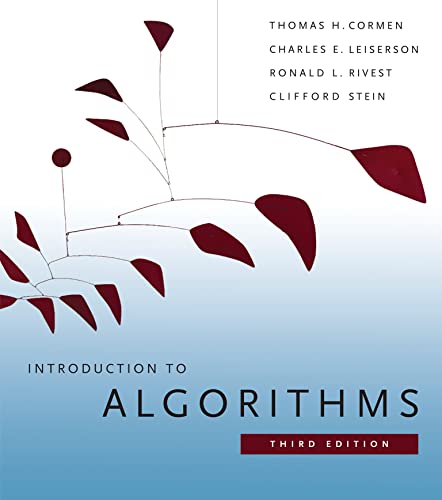
Introduction to Algorithms, 3rd...

Introduction to Algorithms, 3rd...

Publisher
MIT Press
Published
2009
Pages
1292
ISBN-13
9780262033848
Format
other
Language
English

This edition has been revised and updated throughout. It includes some new chapters. It features improved treatment of dynamic programming and greedy algorithms as well as a new n…

Book Summary
Introduction to Algorithms, 3rd Edition, by Cormen, Leiserson, Rivest, and Stein—universally known as CLRS—is the definitive textbook on algorithms. It covers a vast range of algorithms in depth, from sorting and data structures to graph algorithms, dynamic programming, and NP-completeness. Rigorous yet accessible, it balances mathematical analysis with practical design, making it the standard reference for students and professionals.
This book is not available
Best buying and renting options — totals include estimated shipping when seller shipping is unavailable
Store Condition Deals & Coupons Price Est. Shipping Total Buy
About Introduction to Algorithms, 3rd...

Often called CLRS after its four authors, Introduction to Algorithms is the most comprehensive and widely used textbook on algorithms. The third edition expands coverage of dynamic programming and multithreaded algorithms, and updates treatments of van Emde Boas trees and Fibonacci heaps. The book is organized into eight parts: foundations, sorting and order statistics, data structures, advanced design and analysis, advanced data structures, graph algorithms, selected topics, and appendices on mathematical background. Each chapter presents algorithms in pseudocode, analyzes their correctness and running time, and includes exercises and problems. It serves both as a rigorous academic text and a practical reference for programmers, covering topics from elementary sorting to NP-completeness and approximation algorithms.

Who should read Introduction to Algorithms, 3rd...?

This book is essential for computer science students, especially those in algorithms or theory courses, and for software engineers preparing for technical interviews or seeking a deep reference. It suits readers with some programming experience and mathematical maturity, including undergraduates, graduate students, and professionals who need rigorous analysis. Instructors value it as a course text, while researchers and practitioners use it as a comprehensive reference on classical and advanced algorithms.

Pros & Cons
Pros
  • ✓ Unmatched breadth and depth, covering virtually every major algorithm topic
  • ✓ Rigorous mathematical analysis with clear pseudocode for each algorithm
  • ✓ Excellent exercises and problems that reinforce understanding
  • ✓ Written by leading authorities and continuously refined across editions
  • ✓ Serves as both a textbook and a long-term professional reference
Cons
  • ✗ Very dense and lengthy, which can be intimidating for beginners
  • ✗ Requires mathematical maturity, especially in probability and discrete math
  • ✗ Some topics are highly theoretical and less directly practical
  • ✗ Pseudocode may not match a specific programming language, requiring adaptation
  • ✗ The third edition lacks some newer algorithmic developments found in later editions
Frequently asked questions
Is Introduction to Algorithms suitable for self-study?
Yes, but it requires dedication. The book is self-contained with appendices on mathematical background, and the exercises help reinforce concepts. However, beginners may benefit from supplementary online lectures or a more introductory text.
What programming language is used in the book?
The book uses pseudocode rather than a specific programming language, making it language-agnostic. This allows readers to implement the algorithms in any language they choose.
How does the 3rd edition differ from the 2nd edition?
The 3rd edition adds coverage of multithreaded algorithms, expands dynamic programming, and updates treatments of van Emde Boas trees and Fibonacci heaps. It also includes new exercises and clarifications.
Is this book good for interview preparation?
Yes, it is highly recommended for technical interviews, especially at top tech companies. It provides deep understanding of algorithmic concepts, though some interview-focused books may be more concise.
Do I need to read the entire book?
No, the book is designed to be modular. Instructors often select chapters for courses, and self-learners can focus on topics relevant to their needs. The preface provides guidance on chapter dependencies.

At Windsorbooks, we compare prices from trusted sellers so you can buy, rent, or sell textbooks at the best total price — shipping included.

As an Amazon Associate, Windsorbooks.com may earn a small commission on qualifying purchases.
