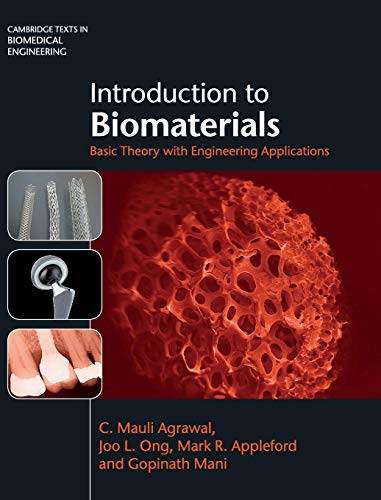
Introduction to Biomaterials: Basic...

Introduction to Biomaterials: Basic...

Publisher
Cambridge University Press
Published
2013
Pages
—
ISBN-13
9780521116909
Format
print
Language
English

This succinct textbook gives students the perfect introduction to the world of biomaterials, linking the fundamental properties of metals, polymers, ceramics and natural biomateri…

Book Summary
This concise textbook by C. Mauli Agrawal offers a one-semester introduction to biomaterials, linking fundamental properties of metals, polymers, ceramics, and natural materials to biomedical applications. It covers sterilization, surface modification, cell-biomaterial interactions, drug delivery, and tissue engineering, with clear summaries of key concepts. Ideal for engineering and materials science students with basic biology knowledge.
This book is not available
Best buying and renting options — totals include estimated shipping when seller shipping is unavailable
Store Condition Deals & Coupons Price Est. Shipping Total Buy
About Introduction to Biomaterials: Basic...

Introduction to Biomaterials: Basic Theory with Engineering Applications is a succinct textbook designed for a single-semester course. It connects the fundamental properties of metals, polymers, ceramics, and natural biomaterials to their unique advantages and limitations in biomedical applications. Clinical concerns such as sterilization, surface modification, cell-biomaterial interactions, drug delivery systems, and tissue engineering are discussed in detail, providing practical insight into real-world challenges. Key definitions, equations, and concepts are concisely summarized alongside the text, helping students quickly identify essential information. The final chapter brings together elements from across the book to discuss modern commercial implants, challenging students to consider future industrial possibilities. Requiring only a basic understanding of biology, this balanced and accessible textbook is an ideal introduction for students of engineering and materials science.

Who should read Introduction to Biomaterials: Basic...?

This book is ideal for undergraduate and graduate students in engineering and materials science taking an introductory biomaterials course. It also suits students in biomedical engineering, bioengineering, and related fields who need a foundational understanding of biomaterial properties and applications. Professionals seeking a concise refresher on clinical concerns like sterilization, drug delivery, and tissue engineering will find it valuable. Readers should have a basic grasp of biology and chemistry.

Pros & Cons
Pros
  • ✓ Concise and accessible, suitable for a one-semester course
  • ✓ Balanced coverage of metals, polymers, ceramics, and natural biomaterials
  • ✓ Integrates clinical concerns like sterilization and tissue engineering
  • ✓ Key definitions and equations summarized for quick reference
  • ✓ Final chapter on commercial implants connects theory to industry
Cons
  • ✗ Requires some basic biology knowledge, which may challenge absolute beginners
  • ✗ Limited depth on advanced topics due to concise format
  • ✗ May not cover emerging biomaterials in detail
  • ✗ Few practice problems or case studies for self-study
  • ✗ Focus on engineering applications may not suit pure biology students
Frequently asked questions
What background do I need to understand this book?
A basic understanding of biology and chemistry is sufficient. The book is designed for engineering and materials science students, so it explains biological concepts as needed.
Is this book suitable for a one-semester course?
Yes, the author explicitly designed it to be concise enough for a single-semester course, covering essential topics without excessive detail.
Does it cover both traditional and modern biomaterials?
It covers metals, polymers, ceramics, and natural biomaterials, and includes a final chapter on modern commercial implants, bridging fundamentals to current applications.
Are there practice problems or exercises?
The book focuses on concise explanations and summaries of key concepts rather than extensive problem sets. It is primarily a textbook for learning core material.
Is this book up-to-date with current research?
While it provides a solid foundation, like any textbook, it may not include the very latest research. It emphasizes fundamental principles and established applications.

At Windsorbooks, we compare prices from trusted sellers so you can buy, rent, or sell textbooks at the best total price — shipping included.

As an Amazon Associate, Windsorbooks.com may earn a small commission on qualifying purchases.
