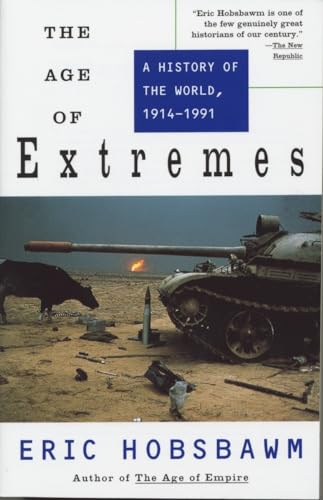
The Age of Extremes: A History of...

The Age of Extremes: A History of...

Publisher
Vintage
Published
1996
Pages
—
ISBN-13
9780679730057
Format
print
Language
English

Dividing the century into the Age of Catastrophe, 1914-1950, the Golden Age, 1950-1973, and the Landslide, 1973-1991, Hobsbawm marshals a vast array of data into a volume of unpar…

Book Summary
Eric Hobsbawm's The Age of Extremes is a masterful history of the 'short twentieth century' (1914–1991), divided into the Age of Catastrophe, the Golden Age, and the Landslide. It offers unparalleled insight into war, revolution, and social transformation, making it essential reading for anyone seeking to understand the modern world.
This book is not available
Best buying and renting options — totals include estimated shipping when seller shipping is unavailable
Store Condition Deals & Coupons Price Est. Shipping Total Buy
About The Age of Extremes: A History of...

In The Age of Extremes, Eric Hobsbawm delivers a sweeping, insightful history of the twentieth century, which he famously termed the 'short century' spanning 1914 to 1991. He divides this era into three distinct phases: the Age of Catastrophe (1914–1950), marked by two world wars and economic collapse; the Golden Age (1950–1973), a period of unprecedented growth and social change; and the Landslide (1973–1991), characterized by crisis and the collapse of communism. Hobsbawm marshals a vast array of data and global perspectives, tracing the shift of historical drivers from Europe to former colonies, the rise and fall of messianic communism, and profound transformations in everyday life. With 32 pages of photographs, this volume stands as a vibrant, inclusive, and deeply personal account of a century that shaped our present.

Who should read The Age of Extremes: A History of...?

This book is essential for students and scholars of modern history, politics, and sociology. It appeals to general readers seeking a comprehensive understanding of the twentieth century's defining events and ideologies. Those interested in the rise and fall of communism, the impact of global wars, and the social transformations that reshaped everyday life will find it invaluable. Hobsbawm's clear prose and analytical depth make it accessible to non-specialists, while his personal reflections add a unique perspective for seasoned historians.

Pros & Cons
Pros
  • ✓ Provides a clear, three-part framework for understanding the twentieth century.
  • ✓ Offers a truly global perspective, moving beyond Eurocentrism.
  • ✓ Combines vast historical data with vivid, insightful analysis.
  • ✓ Includes 32 pages of photographs that enhance the narrative.
  • ✓ Written in an engaging, accessible style suitable for both scholars and general readers.
Cons
  • ✗ Some readers may find Hobsbawm's Marxist perspective ideologically biased.
  • ✗ The book's dense detail can be overwhelming for casual readers.
  • ✗ Focuses primarily on political and economic history, with less on cultural aspects.
  • ✗ The chronological structure may feel rigid to some.
  • ✗ Limited coverage of certain regions, such as Africa and Latin America, in depth.
Frequently asked questions
What is the 'short twentieth century' according to Hobsbawm?
Hobsbawm defines the 'short twentieth century' as the period from 1914 to 1991, framed by the outbreak of World War I and the collapse of the Soviet Union. He argues that this era constitutes a coherent historical unit distinct from the longer century.
What are the three phases Hobsbawm identifies?
The three phases are the Age of Catastrophe (1914–1950), the Golden Age (1950–1973), and the Landslide (1973–1991). Each phase is characterized by distinct economic, political, and social dynamics.
Is this book suitable for someone new to twentieth-century history?
Yes, despite its depth, Hobsbawm's clear writing and structured approach make it accessible to beginners. However, readers may benefit from some prior knowledge of major events.
Does the book include illustrations?
Yes, this edition includes 32 pages of photographs that complement the text and bring the historical narrative to life.
What perspective does Hobsbawm take?
Hobsbawm writes from a Marxist and broadly leftist perspective, emphasizing economic and social forces. While this shapes his analysis, the book is widely respected for its rigorous scholarship and comprehensive scope.

At Windsorbooks, we compare prices from trusted sellers so you can buy, rent, or sell textbooks at the best total price — shipping included.

As an Amazon Associate, Windsorbooks.com may earn a small commission on qualifying purchases.
