
 Wishlist
Book Summary
Flat World, Big Gaps is an edited academic volume examining the paradox of globalization: while economies integrate, inequality persists and often worsens. Through contributions from leading economists, it critiques mainstream trade theory and offers policy alternatives for equitable development. Ideal for students and scholars of development economics seeking a rigorous, heterodox perspective on global inequality.
This book is not available
Store  |
Condition |
Deals & Coupons | Price |
Est. Shipping |
Total |
Buy |
|---|---|---|---|---|---|---|
| Sorry we could not find any result for “9781842778340” | ||||||
About Flat World, Big Gaps: Economic...
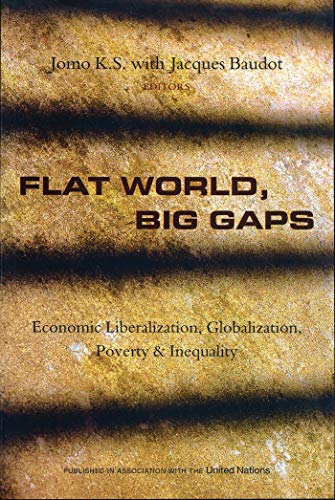
Flat World, Big Gaps: Economic Liberalization, Globalization, Poverty and Inequality is a collection of essays edited by K.S. Jomo and Jacques Baudot. The book challenges the assumption that globalization automatically reduces poverty and inequality. Drawing on empirical studies from various regions, contributors analyze how trade liberalization, financial flows, and labor market reforms have differential impacts across and within countries. The volume critiques neoclassical economic models and presents alternative frameworks for understanding persistent global gaps. It also discusses policy measures to promote more inclusive development. This academic text is valuable for those seeking a critical, evidence-based examination of globalization's social and economic consequences.
Who should read Flat World, Big Gaps: Economic...?
This book is essential for undergraduate and graduate students in development economics, international relations, and political economy. It suits academics and researchers exploring heterodox approaches to globalization and inequality. Policymakers and NGO practitioners working on trade, poverty, and social justice will find critical insights. Readers should have a basic understanding of economic concepts to fully engage with the technical arguments.
Pros & Cons
Pros
- ✓ Provides a rigorous critique of mainstream globalization narratives
- ✓ Includes empirical case studies from diverse regions
- ✓ Edited by respected scholars in development economics
- ✓ Offers policy alternatives for reducing inequality
- ✓ Accessible to advanced students despite technical depth
Cons
- ✗ Assumes prior knowledge of economic theory
- ✗ Some chapters may feel dated given rapid global changes
- ✗ Lacks a unified voice due to multiple contributors
- ✗ Focuses heavily on critique rather than original data
- ✗ Not suitable for beginners seeking an introduction
Similar books


Frequently asked questions
Is this book suitable for undergraduates?
Yes, it is appropriate for advanced undergraduates in economics or development studies, though some chapters require familiarity with basic economic concepts.
Does the book provide solutions to global inequality?
It offers policy alternatives and frameworks for more equitable development, but does not prescribe a single solution; rather, it presents a range of perspectives.
How technical is the content?
The book includes economic analysis and data, making it moderately technical. Readers without economics background may find some chapters challenging.
Is this a textbook or a collection of essays?
It is an edited collection of essays by various economists, often used as a supplementary text in university courses.
Does it cover both poverty and inequality?
Yes, the book examines both poverty and inequality, exploring how globalization affects each and the relationship between them.
At Windsorbooks, we compare prices from trusted sellers so you can buy, rent, or sell textbooks at the best total price — shipping included.
As an Amazon Associate, Windsorbooks.com may earn a small commission on qualifying purchases.