
 Wishlist
Book Summary
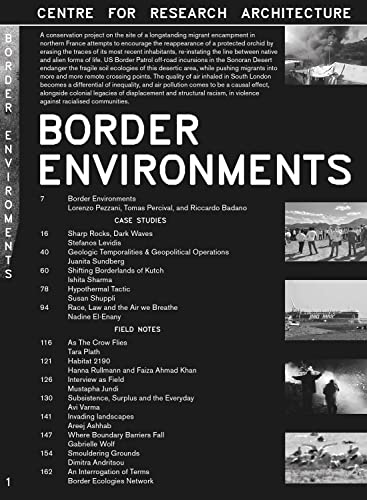
Border Environments: CRA #1 is a cross-disciplinary volume that examines borders as material and spatial conditions rather than mere lines on a map. Through essays, visual research, and case studies by Riccardo Badano, Tomas Percival, and Susan Schuppli, it explores how borders shape environments, infrastructures, and lived experience. This first issue of the CRA series is essential for readers interested in critical spatial practice, migration studies, and environmental humanities.
This book is not available
Store  |
Condition |
Deals & Coupons | Price |
Est. Shipping |
Total |
Buy |
|---|---|---|---|---|---|---|
| Sorry we could not find any result for “9783959056861” | ||||||
About Border Environments: CRA #1
Border Environments: CRA #1 brings together the work of Riccardo Badano, Tomas Percival, and Susan Schuppli to investigate borders as active, material forces that produce environments. Moving beyond geopolitical abstraction, the book treats borders as sites where law, ecology, technology, and everyday life intersect. Through a mix of critical essays, visual documentation, and case-based analysis, it examines how border infrastructures—from fences and sensors to detention facilities and ecological zones—reshape landscapes and bodies. The volume is the first in the CRA series, signalling a commitment to experimental, research-driven scholarship. It will appeal to architects, artists, geographers, and activists who want to understand borders not as static lines but as dynamic systems with environmental and social consequences. The authors combine theoretical rigor with grounded observation, making the book both intellectually ambitious and accessible to readers across disciplines.
Who should read Border Environments: CRA #1?
This book is for scholars, students, and practitioners in architecture, urbanism, geography, migration studies, and environmental humanities. Artists and curators working on spatial and political themes will find it especially relevant. Activists and policy researchers seeking a critical, material understanding of border regimes will also benefit. It suits readers who prefer interdisciplinary, visually informed scholarship over purely theoretical treatises. Advanced undergraduates and graduate students looking for a concise, provocative entry into border studies will appreciate the focused case studies and the book’s role as the opening volume of a new series.
Pros & Cons
Pros
- ✓ Interdisciplinary approach bridges architecture, geography, and environmental studies
- ✓ Concise, focused format ideal for seminar use and quick scholarly reference
- ✓ Strong visual and case-based material grounds abstract concepts
- ✓ Authored by established researchers in critical spatial practice
- ✓ First volume of a series signals ongoing, cutting-edge inquiry
Cons
- ✗ No publisher description available, so readers must infer scope from title and authors
- ✗ May be too specialized for general readers without background in border studies
- ✗ As a first issue, it may prioritize provocation over comprehensive coverage
- ✗ Limited availability and niche appeal could make it hard to find in libraries
- ✗ Visual material may not translate well in all e-book formats
Similar books


Frequently asked questions
What is Border Environments: CRA #1 about?
It is an interdisciplinary volume that examines borders as material and environmental systems, exploring how border infrastructures shape landscapes, bodies, and everyday life through essays, visual research, and case studies.
Who are the authors?
Riccardo Badano, Tomas Percival, and Susan Schuppli are researchers and practitioners known for their work in critical spatial practice, media, and environmental studies.
Is this book suitable for a course syllabus?
Yes, its concise format, case-based approach, and theoretical rigor make it well suited for advanced undergraduate or graduate seminars in architecture, geography, and border studies.
Does the book include visual material?
Yes, the volume incorporates visual documentation and research-based imagery to support its arguments about borders as spatial and material conditions.
What is the CRA series?
CRA likely stands for Critical Research in Architecture or a similar series focused on experimental, interdisciplinary scholarship. Border Environments is the first issue, indicating a series of themed volumes.
At Windsorbooks, we compare prices from trusted sellers so you can buy, rent, or sell textbooks at the best total price — shipping included.
As an Amazon Associate, Windsorbooks.com may earn a small commission on qualifying purchases.