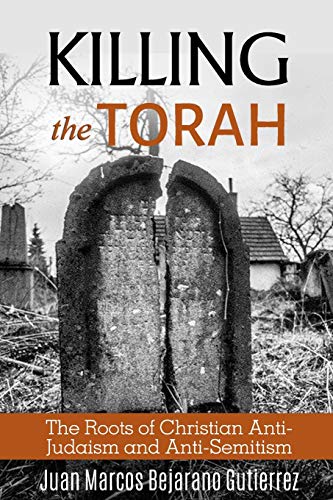
Killing the Torah: The Roots of...

Killing the Torah: The Roots of...

Publisher
Independently published
Published
2020
Pages
94
ISBN-13
9798673814697
Format
print
Language
English

Despite significant improvement in interfaith dialogue in some quarters between Christians and Jews, many Christians still maintain theological positions that are inimical to fund…

Book Summary
Killing the Torah: The Roots of... by Juan Marcos Bejarano Gutierrez explores the historical and theological tensions between early Christianity and Judaism, examining how anti-Jewish polemic and the concept of supersessionism shaped Christian identity. This scholarly work traces the roots of replacement theology and its impact on Jewish-Christian relations, offering a critical analysis of how the Torah was marginalized in Christian thought.
This book is not available
Best buying and renting options — totals include estimated shipping when seller shipping is unavailable
Store Condition Deals & Coupons Price Est. Shipping Total Buy
About Killing the Torah: The Roots of...

In Killing the Torah: The Roots of..., Juan Marcos Bejarano Gutierrez investigates the complex historical and theological processes by which early Christian thinkers distanced themselves from Judaism and the Torah. The book examines the emergence of supersessionism—the belief that the Christian church has replaced Israel as God's chosen people—and how this doctrine influenced Christian self-definition. Gutierrez traces the roots of anti-Jewish polemic in patristic literature, exploring how the Torah was reinterpreted, spiritualized, or rejected outright. He also considers the social and political factors that contributed to the parting of the ways between Judaism and Christianity. This scholarly study provides a nuanced understanding of how the Torah became a contested symbol in early Christian identity formation, shedding light on the historical roots of Christian anti-Judaism and its lasting impact on Jewish-Christian relations.

Who should read Killing the Torah: The Roots of...?

This book is essential for scholars and students of early Christianity, Judaism, and interfaith relations. Historians of religion, theologians, and clergy seeking to understand the roots of supersessionism will find it invaluable. It is also suitable for educated lay readers interested in Jewish-Christian dialogue, the historical development of Christian doctrine, and the complex legacy of anti-Jewish polemic in Western religious thought.

Pros & Cons
Pros
  • ✓ Provides a thorough historical analysis of early Christian anti-Judaism and supersessionism.
  • ✓ Offers a nuanced perspective on the complex relationship between early Christianity and Judaism.
  • ✓ Draws on a wide range of primary sources, including patristic literature and rabbinic texts.
  • ✓ Written by a knowledgeable scholar in the field of Jewish-Christian studies.
  • ✓ Sheds light on the historical roots of contemporary interfaith challenges.
Cons
  • ✗ The academic tone may be dense for general readers.
  • ✗ Assumes some familiarity with early Christian and Jewish history.
  • ✗ Limited focus on the practical implications for modern interfaith dialogue.
  • ✗ Some arguments may be controversial among traditional Christian readers.
  • ✗ Lacks a comprehensive index or glossary for quick reference.
Frequently asked questions
What is the main thesis of Killing the Torah?
The book argues that early Christian identity was shaped in significant part by a rejection of the Torah and Judaism, leading to the development of supersessionist theology that has had lasting consequences for Jewish-Christian relations.
Is this book suitable for academic study?
Yes, it is a scholarly work that engages with primary sources and contemporary scholarship, making it appropriate for university courses and research.
Does the author have expertise in this field?
Juan Marcos Bejarano Gutierrez is a recognized scholar with a focus on Jewish-Christian relations and early Christianity, bringing depth to the analysis.
How does this book address modern interfaith dialogue?
While primarily historical, the book provides essential context for understanding the roots of supersessionism, which is crucial for contemporary Jewish-Christian dialogue and reconciliation.
What sources does the author use?
The author draws on early Christian writings, rabbinic literature, and historical scholarship to trace the development of anti-Torah polemic and its theological implications.

At Windsorbooks, we compare prices from trusted sellers so you can buy, rent, or sell textbooks at the best total price — shipping included.

As an Amazon Associate, Windsorbooks.com may earn a small commission on qualifying purchases.
