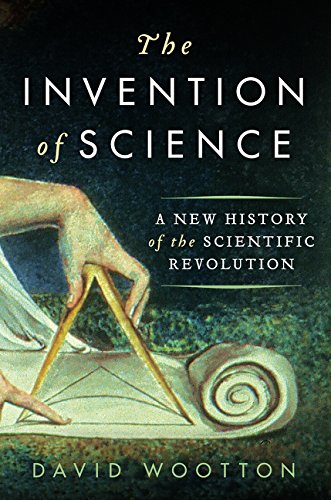
The Invention of Science: A New...

The Invention of Science: A New...

Publisher
Harper
Published
2015
Pages
769
ISBN-13
9780061759529
Format
print
Language
English

"The Invention of Science goes back five hundred years in time to chronicle this crucial transformation, exploring the factors that led to its birth and the people who made it hap…

Book Summary
David Wootton's The Invention of Science argues that the Scientific Revolution was a discrete, transformative event that gave birth to a new culture of evidence and inquiry. He identifies key innovations—the printing press, the telescope, the concept of discovery—that reshaped how Europeans understood nature. This ambitious intellectual history offers a compelling narrative for anyone interested in how modern science came to be.
This book is not available
Best buying and renting options — totals include estimated shipping when seller shipping is unavailable
Store Condition Deals & Coupons Price Est. Shipping Total Buy
About The Invention of Science: A New...

In The Invention of Science, historian David Wootton presents a bold reinterpretation of the Scientific Revolution, arguing that it was not a gradual evolution but a sudden, revolutionary shift in human thought. He contends that between 1572 and 1704, Europeans developed a radically new understanding of knowledge itself—one based on observation, experiment, and the possibility of progress. Wootton traces the invention of key concepts such as 'discovery,' 'fact,' and 'evidence,' and shows how technological advances like the printing press and the telescope accelerated the pace of change. Drawing on a wide range of primary sources, he challenges postmodern views that science is merely a social construct. The book offers a sweeping, erudite narrative that illuminates how the modern scientific worldview emerged and why it remains foundational to our understanding of the world.

Who should read The Invention of Science: A New...?

This book is ideal for readers interested in the history of science, intellectual history, and the origins of modern thought. It will appeal to students and scholars of the Scientific Revolution, as well as general readers who enjoy ambitious, well-researched narratives about how ideas shape history. Those who appreciate detailed arguments and are curious about the cultural and technological forces that gave rise to modern science will find it rewarding.

Pros & Cons
Pros
  • ✓ Offers a bold and original thesis about the Scientific Revolution as a discrete event
  • ✓ Provides deep historical analysis grounded in primary sources
  • ✓ Engages critically with postmodern critiques of science
  • ✓ Written in an accessible yet erudite style for a broad audience
  • ✓ Illuminates the origins of key scientific concepts and practices
Cons
  • ✗ Dense and lengthy, requiring significant time and attention
  • ✗ Some arguments may be controversial among historians
  • ✗ Assumes a basic familiarity with early modern history
  • ✗ Focuses heavily on Western Europe, with limited global perspective
  • ✗ Occasional repetition and tangential detail may slow the pace
Frequently asked questions
What is the main argument of The Invention of Science?
Wootton argues that the Scientific Revolution was a revolutionary event that fundamentally changed how humans understood knowledge, introducing concepts like discovery, fact, and evidence that remain central to science today.
Is this book suitable for someone new to the history of science?
While accessible, it is dense and assumes some background knowledge. Beginners may find it challenging but rewarding, especially with prior reading in early modern history.
Does Wootton address criticisms of science?
Yes, he engages with postmodern and social constructivist critiques, defending the idea that science provides objective knowledge about the world.
What time period does the book cover?
It focuses primarily on the period from 1572 to 1704, a timeframe Wootton identifies as crucial for the emergence of modern science.
How does this book compare to Kuhn's The Structure of Scientific Revolutions?
Both explore scientific change, but Wootton emphasizes a single, transformative revolution rather than Kuhn's cyclical paradigm shifts, and he rejects relativist interpretations.

At Windsorbooks, we compare prices from trusted sellers so you can buy, rent, or sell textbooks at the best total price — shipping included.

As an Amazon Associate, Windsorbooks.com may earn a small commission on qualifying purchases.
