
 Wishlist
Book Summary
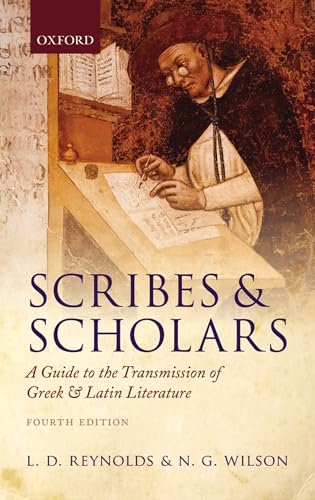
Scribes and Scholars by N. G. Wilson is a classic guide to the transmission of Greek and Latin literature. It explains how ancient texts survived through manuscripts, the role of scribes and scholars, and the principles of textual criticism. This third edition, revised with L. D. Reynolds, remains essential for students of classics, medieval history, and book history.
This book is not available
Store  |
Condition |
Deals & Coupons | Price |
Est. Shipping |
Total |
Buy |
|---|---|---|---|---|---|---|
| Sorry we could not find any result for “9780199686339” | ||||||
About Scribes and Scholars: A Guide to...
Scribes and Scholars: A Guide to the Transmission of Greek and Latin Literature, by L. D. Reynolds and N. G. Wilson, is a standard introduction to how classical texts reached the modern world. It traces the journey from ancient papyri through medieval scriptoria to Renaissance humanists, explaining the work of scribes, correctors, and scholars. The book covers textual criticism, palaeography, and the history of libraries, showing how errors and emendations shaped our surviving texts. This third edition, revised and expanded, includes updated bibliography and examples. It is both a practical guide for students and a fascinating narrative of cultural preservation, ideal for anyone interested in the survival of Western literature.
Who should read Scribes and Scholars: A Guide to...?
This book is essential for undergraduate and graduate students of classics, medieval studies, and book history. It suits anyone studying textual criticism, palaeography, or the history of libraries. Teachers of Latin and Greek will find it a valuable resource for explaining how texts were transmitted. General readers with an interest in the survival of ancient literature, the work of medieval scribes, or Renaissance scholarship will also enjoy its clear, scholarly yet accessible style.
Pros & Cons
Pros
- ✓ Authoritative and widely used introduction to textual transmission
- ✓ Clear explanations of complex concepts like stemmatics and palaeography
- ✓ Covers both Greek and Latin traditions in one volume
- ✓ Updated third edition with revised bibliography and examples
- ✓ Accessible to students while remaining scholarly
Cons
- ✗ Assumes some familiarity with classical languages and literature
- ✗ Dense in places for absolute beginners
- ✗ Focuses primarily on Western classical texts, with limited coverage of other traditions
- ✗ Some examples may feel dated to specialists
- ✗ Lacks extensive illustrations or facsimiles
Similar books


Frequently asked questions
Is this book suitable for beginners?
Yes, it is written as an introduction, though some basic knowledge of classical literature or Latin/Greek helps. The authors explain technical terms clearly.
Does this edition differ from earlier ones?
The third edition was revised and expanded by N. G. Wilson, with updated bibliography and some new examples, making it the most current version.
Is it focused only on Greek and Latin texts?
Yes, the book specifically addresses the transmission of Greek and Latin literature, though its methods apply more broadly to textual criticism.
Can it be used as a textbook for a course?
Absolutely. It is widely assigned in courses on textual criticism, palaeography, and classical philology.
Does it cover digital humanities or modern textual scholarship?
The third edition predates the digital turn, so it focuses on traditional manuscript studies. It remains a foundational text for understanding pre-digital transmission.
At Windsorbooks, we compare prices from trusted sellers so you can buy, rent, or sell textbooks at the best total price — shipping included.
As an Amazon Associate, Windsorbooks.com may earn a small commission on qualifying purchases.