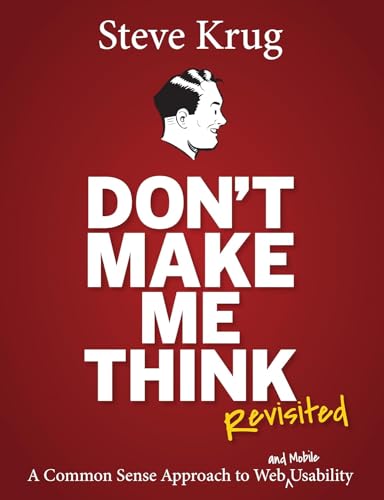
Don't Make Me Think, Revisited: A...

Don't Make Me Think, Revisited: A...

Publisher
New Riders
Published
2014
Pages
200
ISBN-13
9780321965516
Format
print
Language
English

Connecting readers with great books since 1972. Used textbooks may not include companion materials such as access codes, etc. May have condition issues including wear and notes/hi…

Book Summary
Don't Make Me Think, Revisited is a practical guide to web usability and user experience design that teaches designers and developers how to create intuitive, user-friendly websites. Steve Krug emphasizes that good web design should be obvious and require minimal cognitive effort from users. This book is essential for web designers, developers, UX professionals, and anyone involved in creating digital products who wants to understand the principles of effective user-centered design.
This book is not available
Best buying and renting options — totals include estimated shipping when seller shipping is unavailable
Store Condition Deals & Coupons Price Est. Shipping Total Buy
About Don't Make Me Think, Revisited: A...

This revised edition updates Krug's seminal work on web usability with contemporary examples and modern design practices. The book argues that the most important principle of good web design is making everything obvious—users shouldn't have to think about how to use a website. Krug explores why people leave websites, what makes navigation work, the importance of visual hierarchy, and how to conduct usability testing without breaking the bank. The author uses humor and real-world examples to illustrate concepts like information architecture, page layout, and form design. Each chapter focuses on practical, actionable advice that designers can immediately apply to their projects. The revised edition includes updated case studies reflecting current web design trends while maintaining the core principles that made the original book influential. Krug emphasizes that usability isn't about following strict rules but about understanding user behavior and designing accordingly, making this book invaluable for creating websites that users enjoy visiting.

Who should read Don't Make Me Think, Revisited: A...?

This book is ideal for web designers, UX/UI professionals, web developers, product managers, and anyone responsible for creating or improving websites and digital interfaces. It's particularly valuable for beginners in UX design who want to understand fundamental principles without getting overwhelmed by theory. Marketing professionals, content strategists, and business owners who need to understand why their websites succeed or fail will also benefit greatly. Even experienced designers will find value in the revised edition's contemporary examples and updated perspectives on modern web design challenges and best practices.

Pros & Cons
Pros
  • ✓ Highly practical and actionable advice that can be immediately applied to real projects
  • ✓ Written in an engaging, humorous style that makes complex usability concepts accessible and entertaining
  • ✓ Includes updated examples and case studies relevant to contemporary web design practices
  • ✓ Emphasizes cost-effective usability testing methods that don't require large budgets
  • ✓ Covers timeless principles that remain relevant despite rapid technological changes
Cons
  • ✗ Some readers may find the content too foundational if they already have extensive UX experience
  • ✗ Relatively short compared to comprehensive UX textbooks, leaving some topics at surface level
  • ✗ Focuses primarily on websites rather than other digital products like mobile apps or software
  • ✗ Examples, while updated, may eventually become dated as design trends continue evolving
  • ✗ Lacks in-depth technical implementation details for developers wanting specific coding guidance
Frequently asked questions
Is Don't Make Me Think, Revisited: A... suitable for complete beginners in web design?
Yes, absolutely. The book is specifically written to be accessible to beginners while still offering value to experienced designers. Krug uses clear language, humor, and relatable examples that make complex usability concepts easy to understand without requiring prior design knowledge.
How much of the original Don't Make Me Think has changed in the Revisited edition?
The core principles and structure remain the same, ensuring the timeless value of the original work. However, the Revisited edition includes updated examples, case studies, and references that reflect modern web design practices and technologies like responsive design and mobile considerations.
Can I apply the advice from Don't Make Me Think, Revisited: A... to mobile app design?
Many of the fundamental usability principles apply to mobile apps, such as reducing cognitive load and making navigation intuitive. However, the book focuses primarily on website design, so you may need supplementary resources specifically addressing mobile-specific challenges and touch interface considerations.
Does Don't Make Me Think, Revisited: A... include guidance on usability testing?
Yes, the book includes practical advice on conducting affordable usability testing. Krug emphasizes that you don't need expensive labs or large sample sizes to gain valuable insights—even informal testing with a few users can significantly improve your design decisions.
What is the condition of this copy of Don't Make Me Think, Revisited: A...?
This copy is complete and fully readable with all pages and cover intact. It may have light notes, highlighting, or minor water exposure, but nothing affects readability. It may be an ex-library copy with library markings, and the dust jacket or shrink wrap may be missing, but the book itself is in good condition.

At Windsorbooks, we compare prices from trusted sellers so you can buy, rent, or sell textbooks at the best total price — shipping included.

As an Amazon Associate, Windsorbooks.com may earn a small commission on qualifying purchases.
